
The Day the Yadkin Froze Over
- Traphill Angling

- 5 days ago
- 4 min read
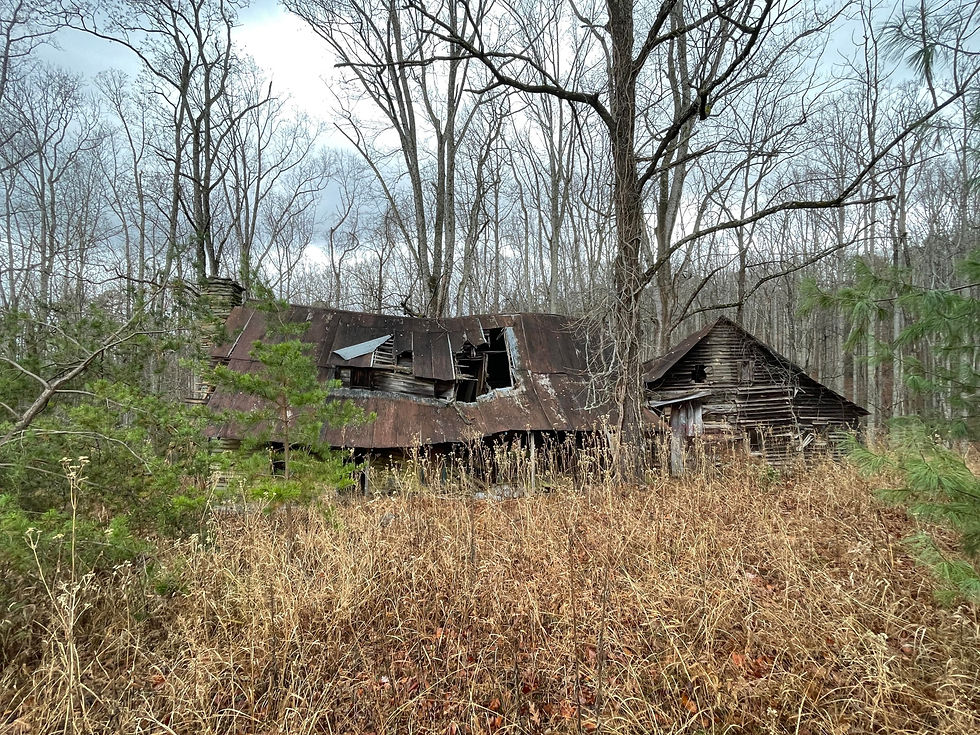
"Pa told me the Yadkin River used to freeze over so solid, they would ride their horse carriages across it," said Stevey Ray McGrady as he leaned against his truck. We were standing in the parking lot of the state park, chatting with a group of other hikers. I personally had a hard time believing a river as large as the Yadkin could freeze, but to call Stevey Ray's pa a liar wouldn’t have been a wise decision. "It used to get a lot colder back then, ya know," he followed up with. I said I would look into it and glanced down at my watch, getting anxious that it was already 9 a.m. on an early spring day. We had just finished up a quick hike to some old homesteads at the edge of the state park boundary and then visited a primitive gravesite from the 1800s. All of this had me deep in thought about how previous generations had lived so differently from us today. I began to think about how things will certainly change throughout the different phases of my life, much as they already have. But today I needed to focus on the present, as I had a grueling hike planned for the remaining nine or so hours of daylight.
There weren’t many creeks in this general area I hadn't fished, but today I intended to visit one of the more remote streams one county over. I drove northwest toward Watauga County and thought about the route I had decided on when studying the topography map for the past few days. My route involved three miles on an official trail before climbing up and over a ridge that should have an old logging road that would get me within a mile or so of this unnamed tributary. I had my Garmin InReach, trekking pole, a packed lunch, water, and my 5'8" 1-weight built by Graywolf Rods.
The first two and a half miles were fairly pleasant before the trail I was on began to show signs of the storm from last year, and the trail itself turned into more of a "used-to-be" path. I crossed the creek and headed up an old logging road that a correspondent had told me about and that I confirmed via satellite imagery before my visit. The gradient began to steepen, and I was entering the start of what was to be a 2,700+ ft elevation gain. Thirty minutes, one mile, and a lot of climbing later, I was at the top of the south-facing slope and looking at an intersection of paths that all went in different directions. To make things more difficult, none of the three paths looked more established or easier than the other. I decided to take the trail that seemed most direct to the creek, and that decision cost me a lot of time and energy, as about a half-mile straight downhill, the path turned into a wall of rhododendron that was impassable. I turned around and walked back up the trail before taking the path going east, and once again wasted my time as it never routed back around the ridge toward the creek.

Finally, having worked harder, not smarter, I took the final option. This old game trail took me another two miles down the ridge before the terrain was so steep, I had to follow a small wet-season spring creek that eventually would connect to the stream I needed to get to. At this point, I had walked 6+ miles and over 2,400 feet of elevation and still hadn't reached the stream. I was close, though, and awfully determined. Thirty minutes later, I finally set eyes on the small, unnamed tributary. After years of Google research, speaking with other anglers and biologists, and studying maps, I had arrived.

The habitat was small but had all the indicators that a population of southern-strain brook trout should be present here. Before long, I confirmed that, catching a unique-looking, dark brook trout with yellow, blue, and orange coloration. I only fished a short half-mile section of the creek, as the habitat quickly flattened out after going through a steep, narrow slot canyon. I also wanted to reserve energy for the strenuous walk back that was now time-sensitive, as the sun would set over the ridge in a few hours. I'll spare any readers the details of how long and difficult that walk back was, but that was one of the happiest moments I’ve ever had, seeing my vehicle right as the sun was setting over the mountain.
I arrived back home shortly after, exhausted and ready to call it a day. Before doing so, I did a quick Google search to see if Stevey Ray's grandpa was telling the truth. Within seconds, it was confirmed that in 1918, the Yadkin River froze so solidly, it was estimated to be eight feet thick. And sure enough, the black-and-white photo attached to the article showed folks in a horse and buggy going over the river. That night, I thought about those pure, remote southern-strain brook trout I had visited along the eastern escarpment, and more importantly, I thought about the day the Yadkin froze over.


Comments